


Introduction
Selecting the right AI model class is critical for engineering teams balancing delivery velocity against monthly API expenditures. As autonomous coding agents become standard across software teams, treating models as interchangeable drop-in replacements often leads to either ballooning token invoices or degraded codebase consistency.
While GPT-6 Luna is positioned as a lightweight, highly economical workhorse, GPT-6.1 Sol provides advanced reasoning and architectural comprehension at a steeper price point. Rather than evaluating these models on synthetic benchmark leaderboards, this analysis examines both engines across end-to-end, agentic software engineering workflows—quantifying token economics, runtime latency, reasoning depth, and task completion speed in production-grade codebases.
Token Pricing & Practical Cost Comparison
Evaluating model economics begins with baseline token unit costs. Both engines feature prompt caching tiers designed to reduce repetitive context ingestion during multi-turn agent sessions.
| Model Class | Input (per 1M) |
Cached Input (per 1M) |
Cache Writes (per 1M) |
Output (per 1M) |
|---|---|---|---|---|
| GPT-6.1 Sol | $2.00 | $0.10 | $2.50 | $10.00 |
| GPT-6 Luna | $0.10 | $0.01 | $0.125 | $0.50 |
On paper, Sol's input and output rates sit at a 20x premium compared to Luna. However, calculating end-to-end operational costs requires accounting for generation efficiency. Total expenditure across agentic loops depends heavily on token verbosity, self-directed tool use, and how many iterative round trips the agent requires to produce a passing build.
Finding the Reasoning Level Sweet Spot
Adjusting reasoning configuration parameters dramatically alters execution latency, reasoning token volume, and overall invoice totals. Maximizing thinking depth does not reliably correlate with cleaner architectural designs. This aligns with the reasoning scorings on ArtificialAnalysis.
- GPT-6 Luna (Recommended: High): Configured at 'High' reasoning, Luna strikes an effective operational balance between code accuracy and generation speed. Dialing Luna up to 'Extra High' produces negligible quality improvements while introducing prolonged wait times and unnecessary intermediate steps.
- GPT-6.1 Sol (Recommended: Medium): Running Sol at 'Medium' reasoning consistently outperforms Luna set to 'High' or even 'Max'. Elevating Sol to 'High' introduces a sharp rise in latency and token burn without offering measurable architectural gains. For Sol, 'Medium' represents the most reliable, cost-effective sweet spot.
Pushing reasoning parameters past their point of diminishing returns is something I observed in an earlier article on how max reasoning in modern models can become a productivity trap.
Test Bed & Benchmark Environment
To test both engines against realistic developer workflows rather than synthetic puzzles, evaluation was conducted on a multi-tier enterprise solution:
- Codebase Architecture: A production-style .NET solution comprising ~35,000 lines of C# spread across 8 cohesive projects. The architecture integrates a client built on the open-source Godot Engine, a standalone .NET server backend, and shared domain game-logic libraries.
- Automated Test Suites: Rigorous test coverage orchestrated through xUnit, paired with specialized game harness libraries (GoDotTest and GodotTestDriver) for headless integration and client interaction tests.
- Developer Environment: Consistent monorepo task execution managed by moonrepo, containerized via the Dev Containers standard and driven through the OpenAI Codex CLI.
Workflow Performance & Observations
1. Work Item Creation and Task Breakdown
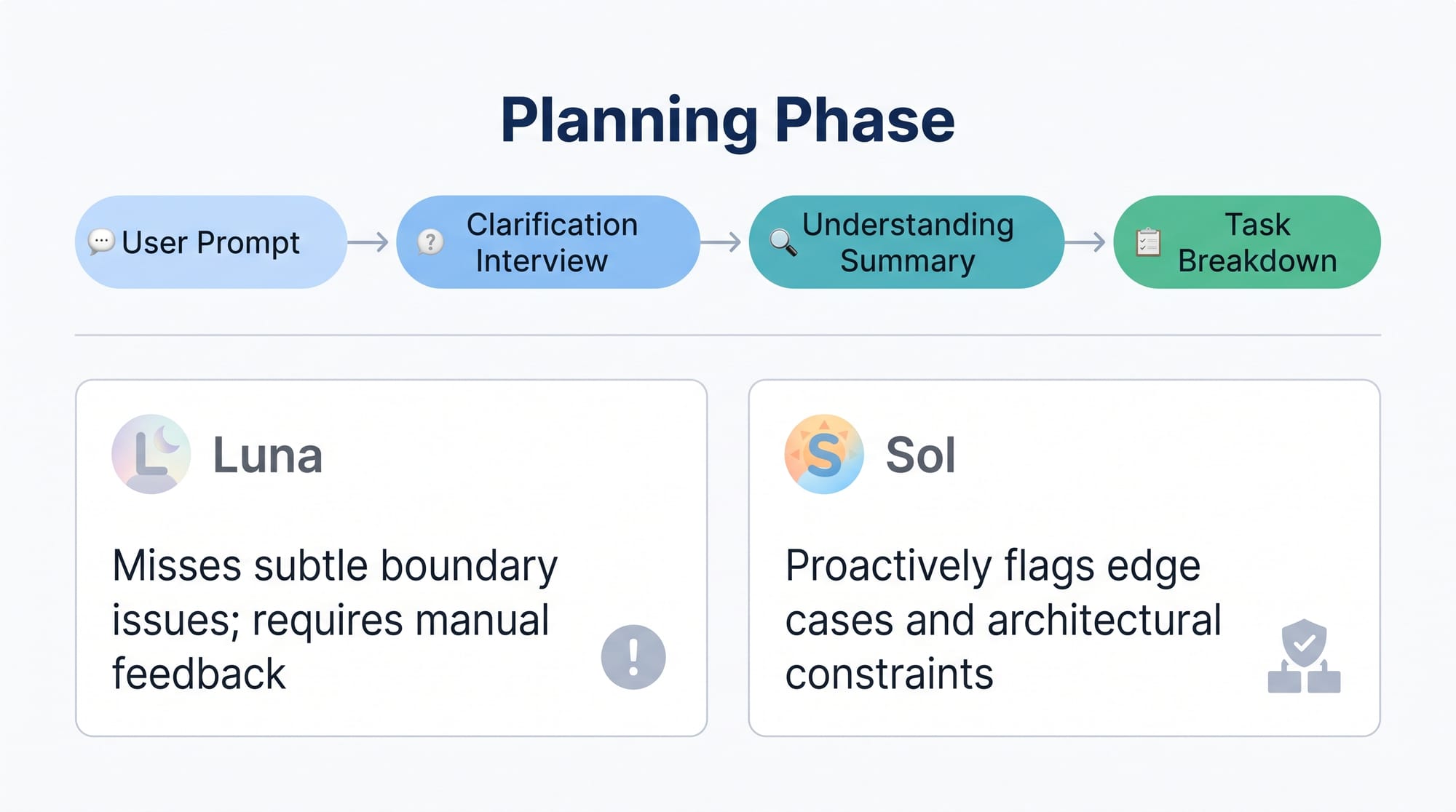
The initial phase mirrors standard engineering sprint planning through a four-stage interactive loop:
- initial feature prompt
- interactive clarification interview
- architectural understanding summary
- formal task breakdown.
Luna Performance
Luna successfully structures tasks into standard formats, but it routinely overlooks peripheral edge cases, state transitions, and integration points. Human developers must repeatedly interject to remind Luna of unhandled boundary conditions before implementation can begin
Sol Performance
Sol conducts a thorough clarification interview, proactively surfacing domain-specific edge cases, thread safety concerns, and contract mismatches early. Its task roadmaps reflect clean component decoupling and align closely with target architectural requirements.
Phase Verdict
Because requirements gathering and planning consume relatively few total tokens compared to code synthesis, Sol is the clear winner for task breakdown and engineering discovery.
2. Implementation with Self-Correction
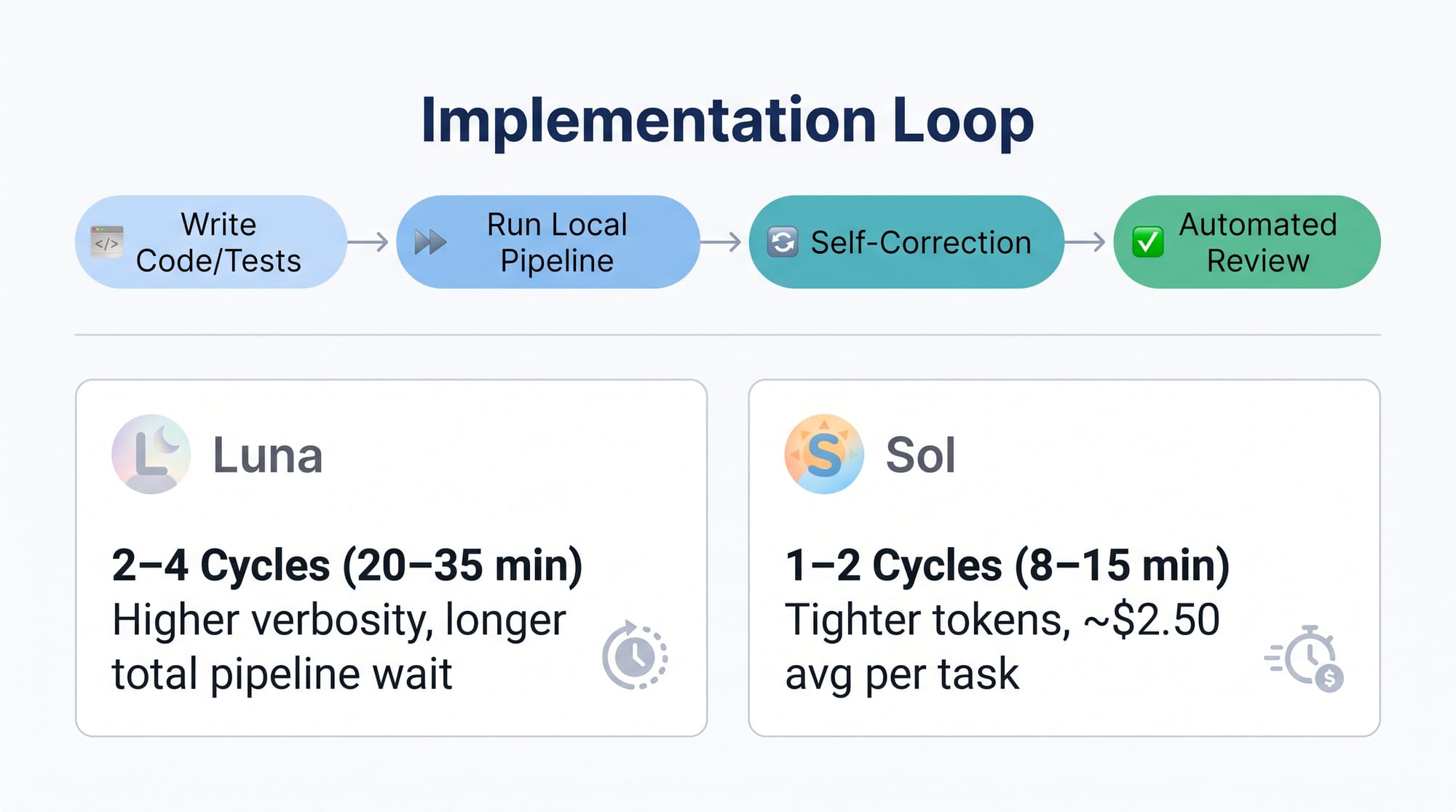
The coding phase adheres to strict Test-Driven Development (TDD) loops. The orchestrator launches subagents to write failing unit tests, craft corresponding feature code, execute local verification pipelines (linting, compiling, and testing), parse error stacks for automatic self-correction, and finally conduct an automated code review pass.
Luna Performance
Luna systematically works through tasks, generating structurally sound, maintainable code. However, it struggles to resolve subtle pipeline failures on the first attempt, frequently requiring 2 to 4 self-correction cycles. With a baseline pipeline build duration of ~1 minute per run, Luna tasks take between 20 and 35 minutes to achieve green builds.
Sol Performance
Sol exhibits greater precision during initial synthesis, typically achieving clean passing runs within 1 to 2 iterations. Sol writes concise implementations without excessive helper bloat or conversational overhead, completing identical tasks in 8 to 15 minutes.
Practical Cost Analysis
Because Sol requires far fewer test-and-repair iterations and generates concise outputs, its real-world token consumption is significantly lower than Luna's on identical assignments. Instead of the 20x price multiple reflected in raw rate cards, Sol averages roughly 10x the operational cost of Luna per task (averaging ~$2.50 per task) while cutting developer waiting time by more than half.
Practical Model Routing Strategy
Balancing engineering velocity against monthly cloud spend requires a deliberate tiering strategy across your toolchain:
GPT-6 Luna (High Reasoning) as the Daily Driver
Route repetitive feature work, boilerplate drafting, standard CRUD updates, and routine unit test generation to Luna. Its minimal token cost makes it well-suited for high-volume automated background tasks where 25-minute iteration loops are acceptable.
GPT-6.1 Sol (Medium Reasoning) for High-Context Deliverables
Route initial work item planning, architectural refactoring, complex bug hunting, and time-critical pipeline blockers to Sol. The time saved on compilation and self-correction cycles easily justifies the cost premium on complex assignments.
Next Steps
Staying on top of model releases and products can be quite demanding. How do you evaluate new models and their reasoning levels?
If you don’t have the capacity to navigate the fast waters of AI products and workflows, Intenics is here to help. Contact us today to shape your AI strategy.


