Using the highest reasoning possible is very common advice. It worked great for me with "low-mid tier" models, such as Gemini 3 Flash, MiniMax M3 and Deepseek V4 Pro.
Benchmarks, such as ArtificialAnalysis agree, as every model I have seen so far achieves a higher score with higher reasoning.
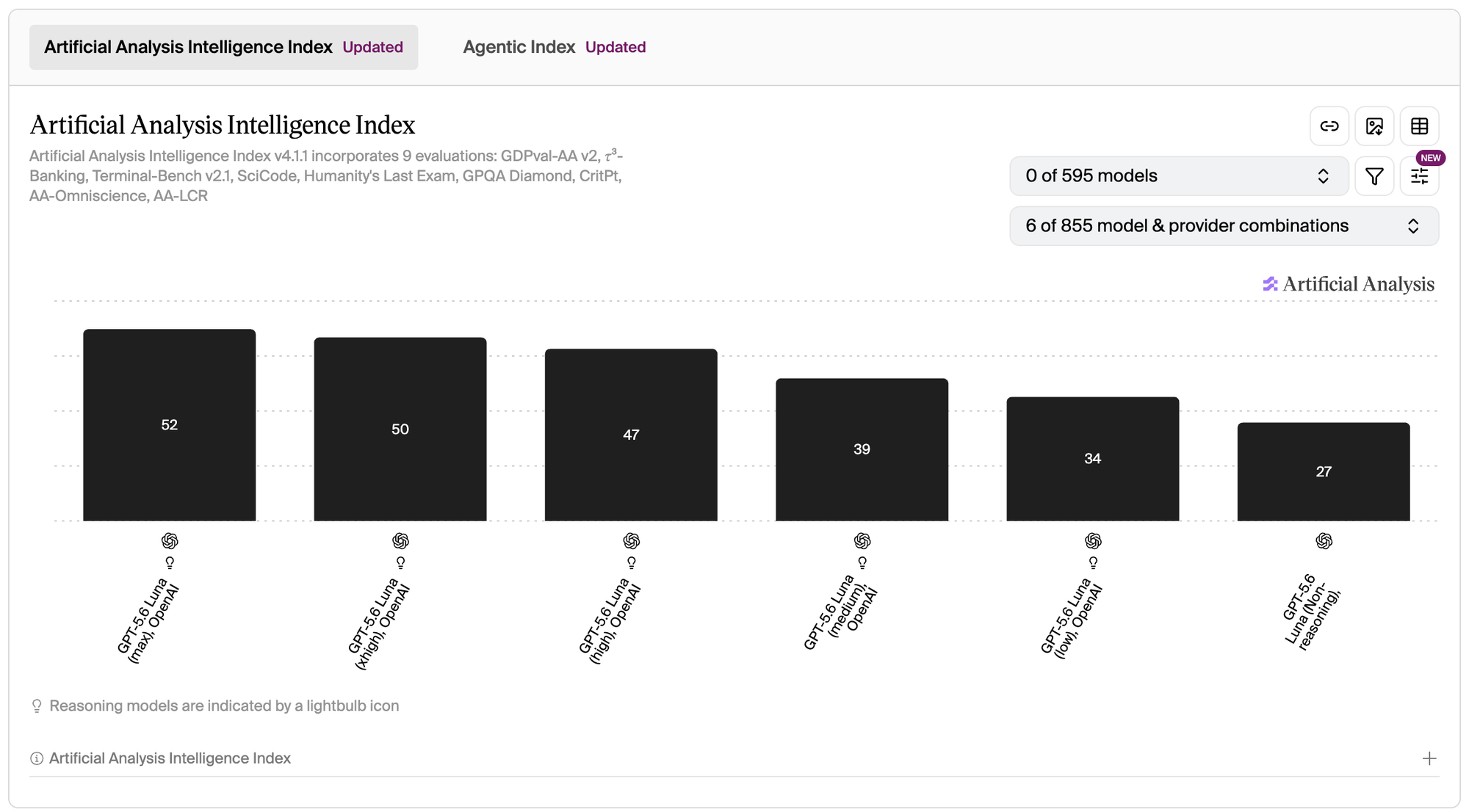
Artificial Analysis Scores for GPT 5.6 Luna with different reasoning effort: Source
Given the recent price drop for GPT 5.6 Luna, it has become my daily driver in OpenCode and I was curious to see the difference between high and max effort. Also, there is GPT 5.6 Luna Pro, which only differs in Reasoning Methods while using the same model and pricing underneath.
Last week, I took some days to actively compare GPT 5.6 Luna with these different reasoning levels.
How I work
First off, let me introduce my workflow. I really like the principle of "Adopt, Adapt, Improve", so I try to start with a common baseline with any technology or methodology.
I adopted Matt Pocock's Agent Skills as my baseline and have already adapted them to my needs, though the outcome is still very similar.To give you a broad overview, it goes a little something like this:
- Interview: My agent interviews me on the work item.
- Create Issue: My agent creates a Github Issue for the work item.
- Review Issue: I review the Github Issue and resume the interview session on aspects that are not right.
- Task Breakdown: My agent cuts the work item into smaller tasks, if necessary.
- Review Tasks: I review the tasks. These usually only need minor corrections.
- Implement Task: My agent implements a task in a subagent.
- Agent Self-Review: My agent reviews the result and fixes critical issues.
- Human Review: I review the results, along with the report from the agent self-review.
GPT 5.6 Luna with High Effort
Although Luna's pricing is very competitive, I started with high reasoning effort out of habit. I remember that GPT-5.3-Codex could get quite expensive with its highest reasoning. This is not relevant for GPT 5.6 Luna, which is why this blog post exists.
It's not much of a surprise, but Luna 5.6 high gave me good results and I was happy with it. But I did ask myself if I can get better output with higher reasoning.
Of course one could use a stronger model, but the cost difference is immense:
- GPT 5.6 Terra: 10 times the price of GPT 5.6 Luna
- GPT 5.6 Sol: 25 times the price of GPT 5.6 Luna
GPT 5.6 Luna with Max Effort
This is where things get interesting. My expectation was that, given the benchmark results, GPT 5.6 Luna would simply output more reasoning tokens and provide slightly better results. So maybe 10% more time for 10% better results.
In reality, these extra reasoning tokens motivated GPT 5.6 to overthink simple issues and deep dive into side topics. It got most tasks done, but took significantly longer.
High vs Max: Direct Comparison
While I have used High and Max for different tasks for a few days, I wanted to have a more direct comparison. I had one complex task, which I solved once with high and once with max reasoning:
Set up a docker image, so that visual integration tests with the Godot Engine can run without a real gpu or display within the container.
The agent ran inside of the container, so it could explore installed packages, generate and read errors, etc. It did not, however, have access to the docker cli to build and test the actual image. With this limitation, I did not expect a perfect solution.
High Reasoning
With high reasoning, 5.6 Luna got 80% of the job done, but failed to solve it completely. It found out how to run the visual tests successfully in the container, using xfvb to create a "virtual display server". The docker image was not fully set up though and the prerequisites in the final response were incomplete.
After a little tinkering, I got the last 20% done and it worked! I was quite happy with this result.
Max Reasoning
Max reasoning would have given me a more complete, functional solution, if it had actually finished. However, it went on a side quest to read the linux source code to understand the graphics stack. It was not in an endless loop, but it was already nearing the 1M context loop and I did not want to wait 2 hours for my result.
It found out how to set up xfvb and use xfvb-run, so that the virtual display server does not run in the background forever.
After reading some of the session, I got some vital insights into the behaviour of xfvb-run, which I actually used to improve the version I had gotten from the High Reasoning solution.
As I was able to gain something valuable from this session, I would not consider this a failure.
Bonus: GPT 5.6 Luna Pro
I also tried using 5.6 Luna Pro for one work item and while the code looked good, it took really long to come to a conclusion. It amplified the pros and cons that I observed with Max Reasoning very noticeably.
5.6 Luna Pro will take a place in my toolbelt, but will only be used rarely. I can see it being great for Analysis tasks or problems with a narrow scope.
My Verdict
The complex task was just a single run for each reasoning effort. While these results do match my general experience over the last days with High and Max Reasoning, repeating that task would likely yield different results.
While Max Reasoning did provide value to me, I do not like the long runtime for my daily driver. I will consider using it for specific workloads or brainstorming that need more reasoning.
GPT 5.6 Luna with High Reasoning will remain my daily driver, as it meets a good balance between solution quality and speed.
I'm really glad I went on this journey, as using high reasoning is now an informed decision, rather than a random gut feeling. This is a key aspect of how we introduce and optimize agentic workflows for our customers at Intenics (german).